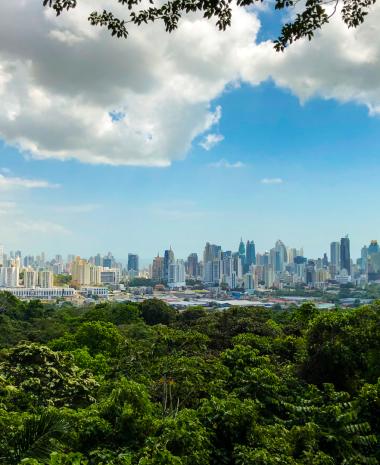
Panama City
Panama City is much more than the country's capital. Here you can pedal in front of a skyline...
Your browser is not supported for this experience.
We recommend using Chrome, Firefox, Edge, or Safari.
The Guna people, one of the country’s most prominent indigenous communities, are an example of the fight for autonomy and for the protection of their lands and the environment. Take part in an immersive cultural experience to learn about their worldview and their fascinating history while exploring one of the most remarkable landscapes on the Caribbean side of Panamá.
The Guna people have three indigenous regions: Guna Madugandí, Guna de Wargandí, and Gunayala. The Gunayala region, also known as San Blas, is an archipelago off Panamá’s east coast in the Caribbean, and it receives the most visitors of the three regions. The archipelago comprises more than 365 islands of all sizes, with white sand, turquoise water, and coconut palms. Here, you’ll get a unique look into the Caribbean while enjoying a perfect vacation.
The Guna people in Panamá migrated to this region from neighboring areas at the end of the 16th century. They often moved around, but when they arrived in the forests and coasts of Darien, they found a home where they could settle permanently.
After centuries of persecution and struggling to maintain their identity, first during the Spanish conquest and then with the government of an independent Panamá, they achieved one of the most important feats for indigenous communities in the region.

In 1925, Nele Kantule and Simral Colman led the Guna Revolution to fight against the oppression of the government, who sought to homogenize the Panamanian people by suppressing ancestral traditions.
Through this revolution, the Guna achieved something that was unthinkable up until that time: the legal and administrative independence of their territory. What started as an uprising and turned into an attempt to create an independent nation, ended in the development of the concept of the comarca—a territory led, managed, and governed by indigenous laws while remaining part of Panamá.
This historical moment served as a successful example, and it was replicated by other indigenous communities in the country and the region. In addition to this struggle and its impact on the history of Panamá, the worldview and culture of the Guna people are key parts of understanding what defines us as a country.
The belief system of the Guna people in Panamá is based on a strong connection to Mother Earth, which was created by Babdummad and Nandummad (the Great Father and Great Mother). In this system, human beings are equal to all other beings on the planet and in the cosmos, so all of nature must be respected and protected.
Due to this ideology, the Guna regions maintain some of the most natural landscapes and the best conserved forests in the country.
Although many ancestral customs have changed or adapted over the years, the six Sagladummagan, or caciques—three in the Gunayala General Congress and three in the General Congress of Culture—are responsible for keeping the Guna identity alive and protecting the rights and duties of the community and its territory.
The Silamar, guides and historians, relate the history and values of their identity through songs and oral histories while the Sagladummagan provide leadership as caciques.
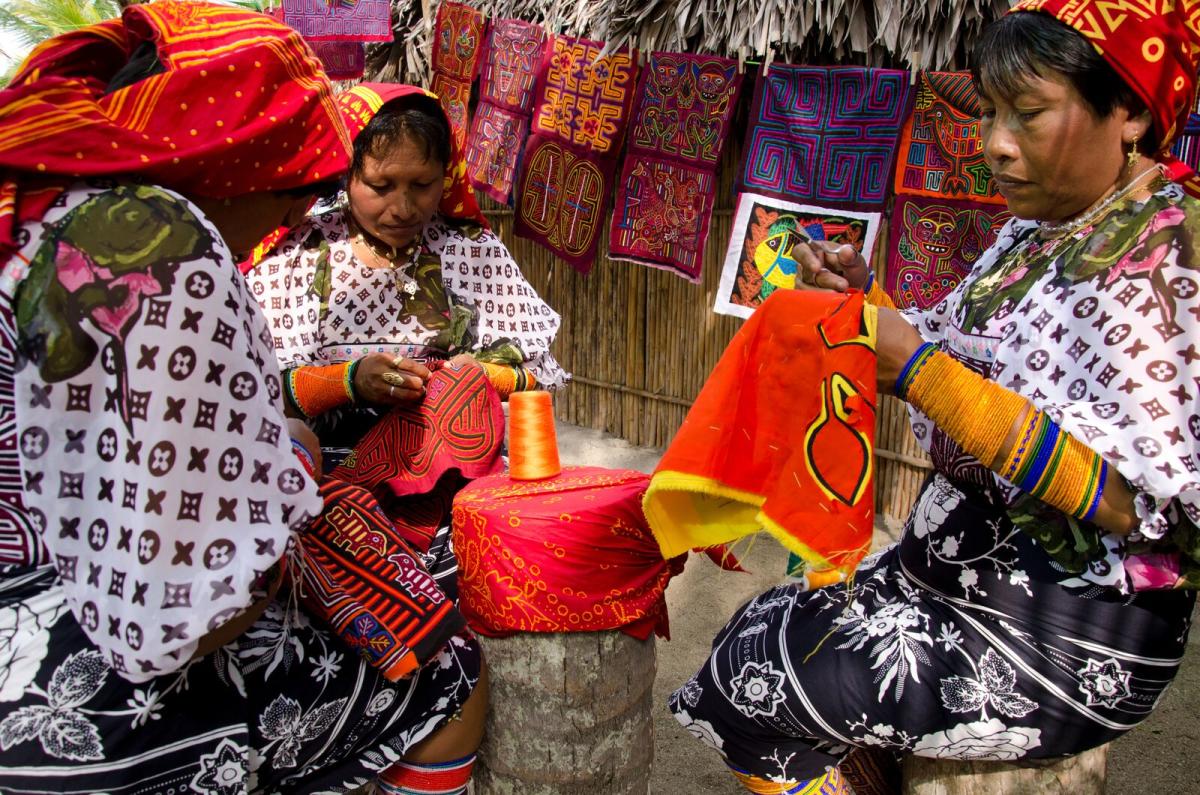
The Guna culture has many artistic traditions. The people are represented by great poets, singers, visual artists, and cooks, but nothing stands out as much as the mola.
Panamanian molas are a characteristic piece of clothing for women, who are at the forefront of preserving their identity and values. Seeing a Guna woman means seeing a woman who is proud of her origins. These textile pieces decorate the front and back of traditional dresses.
Molas feature colorful designs that depict sacred animals or stories about the origin of the universe based on their belief system and on the importance of Mother Earth and Abiyala—the name for the Americas in the Guna language, which has been adopted and used by different communities in the Americas.
Today, the mola is also a key part of the economy for the Guna people in Panamá. This handicraft has become very popular due to its beauty and striking colors. The designs are so unique that you’ll never find two identical molas. Each one is different and will feature special details from the artisan who made it. If you’d like to take a mola home with you, you can buy one either in the Guna regions or in handicraft markets in Panama City and the rest of the country.
The Guna people have a long history of trade, with an economy based on fishing, agriculture, handicrafts, and tourism. Economic success and self-determination are strongly rooted values in the community, which is why they’ve been able to operate independently for so long.
Visiting the Guna communities requires going to the Gunayala archipelago, also known as San Blas. This is not a typical mainstream vacation on a Caribbean island, but rather a cultural experience within the context of community-based ecotourism.
Visit pristine beaches, explore natural pools that are perfect for snorkeling, stay on the islands in rustic cabanas with straw roofs built over the water, rent a hammock, or go camping. These plans are ideal for enjoying nature completely.
If you want to have a more exclusive experience while learning about the Guna culture and the San Blas Islands, you can book a sailboat tour to explore the archipelago from a different perspective with a touch of luxury.
When you visit, be sure to try the unique cuisine centered on seafood, including a fish and plantain soup called tule masi, or a red porgy caught that very day and served with coconut rice. And, of course, sip a refreshing coconut water from a fruit that was just cut off the palm tree.
Though the Guna people in Panamá have continually fought for control of their territory, they don’t shut out those who want to discover their landscapes. Tourism has gradually become an integral part of their economy, always grounded in the autonomy of their community.
By visiting the Gunayala region, you’ll contribute directly to the local economy. The Guna operate under a community-based, circular economic system: you must pay taxes for entry, transportation, the use of boats, and stays on the islands. Each payment goes directly to families in the community and all activities are supported by their agreements and tourism offices.
You’ll enjoy a complete experience of community-based tourism in Gunayala—culture, nature, and adventure—while supporting an independent economy and a model of sustainable ecotourism.
To get to the San Blas Islands from Panama City, you must travel in a 4x4 vehicle for approximately 3 hours to the port of Carti. From there, you’ll continue by boat; the distance depends on which island you’ve decided to visit.
To visit the Gunayala region, you should book a tour in advance. Make sure the tour operator you choose is certified and authorized to enter Guna territory. Most tours include transportation from your hotel to the port or the island you’ve chosen.
Be sure you always book tours offered or supported by members of the community. Book in advance, choose the destination you would like to visit, and review the included services carefully.
Remember that you’ll be visiting an ancient community, with its own beliefs, culture, and rules: go with an open mind and the utmost respect.
Panama City is much more than the country's capital. Here you can pedal in front of a skyline...
Learn about tradition and nature through the eyes of Panamá’s 7 indigenous communities....
Agricultural tourism in Panamá is a unique adventure in the heart of nature. During this...
Panamá, uniquely positioned as the isthmus connecting North and South America, provides a...