World-class Fishing in Panamá

With over 2,900 km (1,800 miles) of coastline, bordered by the Caribbean Sea on one side, the Pacific Ocean—home to world-record fishing—on the other, and rivers and lakes teeming with unique biodiversity in between, Panamá is an unparalleled destination for sport fishing. And it’s not just us saying so: the quality and quantity of fishing that has brought worldwide fame to the Panamanian Pacific is something you can experience for yourself. Whether you prefer deep-sea, inshore, or freshwater fishing, Panamá has what you’re looking for.

Join the hundreds of travelers from around the world who come to Panamanian waters to practice this sport. Here, you’ll find some of the best spots for fishing for large species like yellowfin tuna, wahoo, marlin, and many more.

A crew of people fishing in the depths of the sea.

Why Panamá

You’ll be happy to know that in Panamá, you can go fishing at any time of the year, and don’t need a license for sport fishing either.


During Panamá’s rainy season, from March to the end of December, larger fish move closer to the shore, creating the perfect time for fishing for pelagic species such as mahi-mahi, wahoo, and more. And in the dry season, the upwelling phenomenon creates the ideal ecosystem for catching deep-water fish such as blue, black, and striped marlin, as well as sailfish, among others.


Fishing in Panamá is so important that, historically, it has been awarded over 450 records on the IGFA world record list, of which over 150 are still valid in 2025.

A large Marlin leaping out of the water. It has a long, pointed bill and a blue and white body.

World Records in Bahía Piña

Bahía Piña, located in the Darien province, is one of the most incredible fishing spots in Panamá. Most of the country’s world fishing records have been achieved right here, with species of Pacific sailfish and marlin. Secluded and surrounded by lush rainforest, Bahía Piña is home to Zane Grey Reef, a large underwater mountain that rises from the seafloor and peeks over the surface. Here, those who want to fish recreationally will find an abundance of cockfish, swordfish, marlin, tuna fish, mahi-mahi, snapper, snook, dolphinfish, wahoo, barracuda, and blue, black, and striped marlin. 


You can reach Bahía Piña by private plane, departing from Marcos A. Gelabert International Airport to Bahía Piña Airport. You can also rent a yacht or book a fishing tour departing from Panama City or San Carlos. 

Individuals on a tiny fishing boat.

Fishing in the Tuna Coast

Pedasi is a fishing village well known for its first-rate sport fishing. Get ready to visit one of the most productive fishing areas in the whole Pacific, with species such as cockfish, cubera snapper, amberjack, tuna fish, wahoo, dolphinfish, grouper, marlin and many others.


How does fishing in a region teeming with “bluefin tuna” sound? Discover why the coast of the towns of Pedasi, Venao, and Cambutal earned the name the “Tuna Coast.”


Visit us between May and July to try to catch enormous tuna fish that can exceed 200 pounds (almost 90 kilos).

A fisherman showing a huge fish on a boat

Fishing in the Gulf of Chiriqui

The Gulf of Chiriqui stretches along the Pacific coast, southwest of Panamá. It boasts abundant vegetation, stunning white-sand islands and one of the largest coral reefs in the Pacific, making it one of the best destinations for sport fishing, diving and snorkeling.


During your visit, don’t miss out on Hannibal Bank, an area with an abundance of yellowfin tuna, blue and black marlin and Pacific sailfish. You can also go to Montuosa Island, well known for its huge billfish and lots of tuna. It is also an excellent source of grouper and salmonet snapper.


If you are looking for other species, such as the cockfish, king mackerel and wahoo, set up your trip on Parida Island. Surrounded by mangroves, Parida is also an underwater sanctuary for turtles and marine life.

Group boating at Gatun Lake on a sunny day

Fishing in the Panama Canal Watershed

As for freshwater fishing, the best spots are found in a unique place in the world: Gatun Lake. An artificial lake that was designed and built as fresh water storage for the operation of the Panama Canal locks.


Gatun Lake is located in the south of the province of Colon, 30 minutes by car from Panama City and has a length of 436 km² (168 miles²). If you want to fish there, the typical access is from Gamboa, a town that is practically mid-canal, where the Pacific Ocean and the Caribbean Sea meet. There, you will take a motorboat from where you will cast your rods to fish the great abundance of sergeant fish that inhabit the lake.


The biodiversity of the Panama Canal watershed is so unique that it offers fishing opportunities unlike anywhere else. About 60 years ago, it was discovered that the Royal Shad or tarpon, a species once thought to be exclusive to the Atlantic, uses the canal’s waters to make a transoceanic journey unlike any other in the world. Only in Panamá can you fish for this species on both coasts.

Individuals proudly displaying their freshly caught fish.

Fishing in the Pacific Coast of Veraguas

On the Pacific Coast of Veraguas, you will find the Gulf of Montijo, an area full of lush vegetation and mangrove forests that offers almost 100 km (over 60 miles) of winding channels to explore.


From the Pacific Coast of Veraguas, you can venture to the remote paradise of Cebaco Island or Coiba National Park, two idyllic islands teeming with marine life and where you can fish for species like tuna and wahoo. You can arrange your visit from the beaches of Santa Catalina, a town very popular with marine wildlife enthusiasts.

Woman showing the catch of the day, on a boat on a rainy day

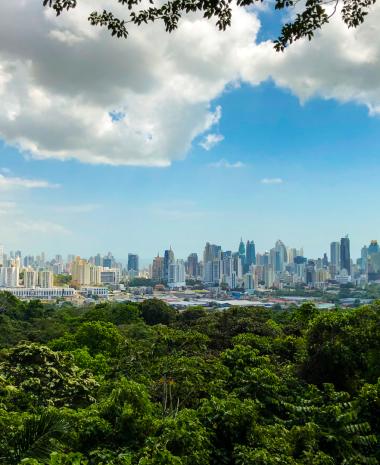
Fishing in Panama City

The Gulf of Panama is the Pacific gateway to the Panama Canal. From here, you can visit several world-class fishing spots. Within the gulf area, you’ll find bays and inlets perfect for a day of fishing: set sail for Panama Bay, the Gulf of Parita, and the Gulf of San Miguel.


In the heart of the Gulf of Panama lies Las Perlas Archipelago. With over 200 islands and islets—many uninhabited—it’s an ideal spot for premium fishing. And no matter when you visit, you can enjoy excellent fishing trips all year round.


As if that weren’t enough, Las Perlas is full of beautiful white-sand beaches and crystal-clear waters, all easily accessible. Enhance your fishing trip with a diving excursion, birdwatching, or a day at the beach exploring nature and marine life.


And if you’re lucky and come between July and October, you’ll be able to see the humpback whales that visit us year after year.

The image shows a group of fishermen on a boat reeling in a large fish. The fish is partially visible in the water, and it appears to be a marlin or a sailfish. The fishermen are working together to bring the fish onto the boat.

Raising the Flag of Sustainability and Conservation

Panamá has the strictest fishing regulations in Central America. By law, killing any billfish is prohibited; these fish are reserved solely to be caught and released. Species such as black marlin, blue marlin, striped marlin, white marlin, spearfish, sailfish, and swordfish are exclusively for sport fishing. Closed seasons and minimum sizes are also established to ensure the reproduction of fish species destined for human consumption.


Try to arrange your fishing trip with certified tour operators. They will watch over our waters and sea life, and will share their knowledge with the travelers on board to ensure responsible fishing practices.


Where to Fish in Panamá

Panamá is a paradise for sport fishing enthusiasts, with top destinations like the Pacific Coast of Veraguas, Riviera Pacifica, Panama City, the Panama Canal, Pedasi, and Tonosi. From breathtaking landscapes and crystal-clear waters to urban fishing with iconic views, each location offers a unique experience. Explore these destinations and discover why Panamá is the perfect place for your next fishing adventure.