10 Days in Panama City
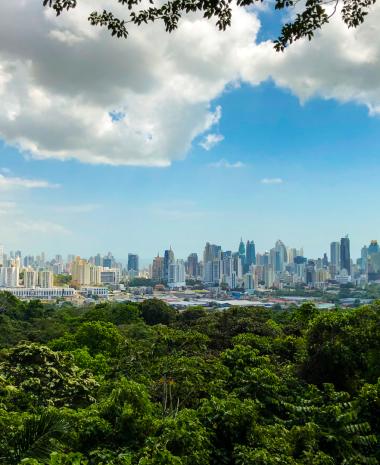
A modern metropolis located between the lushness of the rainforest and the Pacific...
Your browser is not supported for this experience.
We recommend using Chrome, Firefox, Edge, or Safari.
On your next vacation in Panamá, come explore this national park, which not only protects the unique biodiversity of the Panama Canal watershed but also the history of the continent.
Follow one of the first trade routes that connected the Americas with the rest of the world and that was so important that it was named a World Cultural Heritage site by UNESCO.
Camino de Cruces National Park protects more than 4,000 hectares of forest between Panama City and the town of Gamboa, in the province of Colon.
If you love nature, you want to explore a tropical forest for the first time, or you’re passionate about history, Camino de Cruces National Park should definitely be on your list of things to do when you visit our capital.
The History
When they arrived at the “South Sea,” the conquistadors understood that the Panamanian jungle would be the key point of connection on their trade routes. From then on, the ports of Portobelo, in Colon, and Panama Viejo, in Panama City, saw a large part of world trade pass through.
Camino de Cruces National Park protects the remains of the first part of this route, built in 1527. The journey was made in two parts: the first section was a path through the jungle built by hand and set with stones that formed a kind of “road” to make passage easier in extreme conditions. The second part continued by canoe, from Venta de Cruces to the Caribbean port.
The Biodiversity
Camino de Cruces National Park, along with Soberania National Park, Chagres National Park, and other protected areas, forms a real wildlife corridor that protects biodiversity in the Panama Canal watershed, from the Pacific coast to the Caribbean coast. This area is special because, just as it was key for world trade, it has also been a key natural point of contact between species.
Camino de Cruces follows almost the same route as the Panama Canal today, at the narrowest point on the continent. This allows species from the Pacific and Atlantic to coexist as they travel through rivers and natural lakes, as well as artificial bodies of water that feed into the canal. Some species stayed and evolved in this unique region while others keep arriving from both sides.
While exploring the park, you’ll see plant life typical of a tropical forest—trees like the cuipo, ceiba, barrigon, and wild cashew, as well as flowers, mosses, fungi, and much more. You’ll also be able to see a large variety of birds, such as oropendolas, toucans, trogons, and parrots, as well as mammals like monkeys, agoutis, coatis, sloths, anteaters, and if you’re really lucky, even lesser capybaras, locally known as “ponchos.”
The best way to explore the park is by following one of its trails. You can do the easiest trails on your own, since they are short and well marked. To do the longer trails, it’s best to hire a specialized guide. This way, you’ll learn a lot and stay safe as you hike, with everything you need to enjoy the experience.
El Pescador Trail: Easy–Moderate
This 1.8-mile hike (3 km) is perfect if you want a slight challenge as you explore the jungle, but one you can easily complete, even if you’re not in great physical shape. You’ll walk under the shade of the trees for most of the hike, so the sun and heat won’t feel as strong.
At the end of the trail, there’s an area next to the river that’s perfect for enjoying the scenery and recharging before heading back. Remember that this river is home to crocodiles and snakes, so swimming is prohibited. During the green season, the forest teems with life and the river is at its most beautiful.
Buho de Anteojos Trail: Moderate
This 1.24-mile trail (2 km) is special for advanced bird-watchers or those who want to get into bird-watching. Although there are some steep sections on the trail, you don’t need special training. You’ll have many opportunities to spot different species of birds, including the trail’s namesake, the spectacled owl.
Camino de Cruces Trail: Moderate–Strenuous
This is the main trail in the park. If you do the whole trail, from the park entrance in Panama City to Venta de Cruces in Gamboa, you’ll see part of the original stone path. This 7.77-mile section (12.5 km) will lead you along rivers and through the jungle, with natural scenery full of history.
At the end of the trail, you’ll reach the Chagres River. Depending on the tour you’ve booked, your adventure may continue by kayak or boat to explore Chagres National Park before returning to the city.
The park administration offices are less than 20 minutes from the center of the city.
By car: Take the Via Centenario, Panamá–La Chorrera Highway. The park offices don’t appear on Google Maps, so we recommend setting your destination as “Sendero de los Anteojos” or “Sendero Camino de Cruces” and following the directions. You can also follow the signs leading to Merca Panamá, Panama City’s central market, which is on the other side of the highway. As you approach, you’ll see the signs for the park entrance.
By bus: From wherever you are, take the metro to San Miguelito station or Cincuentenario station. Transfer to bus route C678 or C974 and get off at the Camino de Cruces stop.
Be sure to pass by the office to check in so the park rangers have a record of your visit.
How much does entrance to Camino de Cruces National Park cost?
At the beginning of 2026, the prices are:
Children under 12 years old: free
Retirees: USD 1
Students: USD 1
Citizens of Panamá and foreign students: USD 2
Non-nationals: USD 5
Where can the entrance fee for Camino de Cruces National Park be paid?
Before entering the park, you should pay online through the Ministry of Environment’s website.
When is Camino de Cruces National Park open?
It is open every day, from 7:00 a.m. to 3:00 p.m.
A modern metropolis located between the lushness of the rainforest and the Pacific...
Learn about tradition and nature through the eyes of Panamá’s 7 indigenous communities....
Panamá connects the world, and not only because it’s the bridge between North and...